To improve rural living standards, it is really important to have access to safe and reliable drinking water. To address this need, the Government of India launched the Jal Jeevan Mission (JJM) in August 2019 with the objective of providing functional household tap connections to rural households.
But this year, the programme has entered a major new phase with Jal Jeevan Mission 2.0. The revamped mission moves beyond simply installing pipelines and household taps. Its focus is now on ensuring that water supply remains safe, adequate, regular and sustainable while strengthening local accountability, operations and maintenance, water quality monitoring and digital governance. The Union Cabinet approved JJM 2.0 on March 10, 2026, which may extend the mission until December 2028.
In this guide, we cover everything in detail about JJM 2.0, JJM login, registration, and eligibility. Additionally, you will learn about several other things as well, including rules, budget, benefits, digital systems and the practical process for accessing JJM related information.
What Is Jal Jeevan Mission?
Jal Jeevan Mission is also known as JJM or Har Ghar Jal. It is a Government of India programme implemented in partnership with States and Union Territories. It was launched on August 15, 2019, primarily to offer safe and adequate drinking water through Functional Household Tap Connections (FHTCs) to rural households.
Well, the mission is not limited to connecting a pipe to a house. Its wider approach includes-
- Water source sustainability
- Rainwater Harvesting
- Groundwater recharge
- Greywater coverage substantially
When JJM was launched, around 3.23 crore rural households had tap water connections. According to government data cited in 2026, the programme has expanded coverage substantially, while the remaining challenge has increasingly shifted towards ensuring that connections remain functional and that water services are reliable over the long term.
What Is Jal Jeevan Mission 2.0?
Jal Jeevan Mission 2.0, or JJM 2.0, is the restricted and extended phase of JJM. The biggest change is its shift from an infrastructure focused approach to a service delivery model. In simple terms,
JJM 1.0
Focused heavily on creating the infrastructure needed to deliver piped water.
JJM 2.0
This asks a more important question: Does the infrastructure continue to deliver safe and adequate water to households on a regular basis?
The new framework therefore gives greater importance to operation and maintenance, water quality, source sustainability, accountability and community ownership.
What is JJM 2.0 Budget and Timeline?
One of the biggest updates in 2026 is the enhanced financial outlay for the mission.
Budget
The Union Cabinet approved a total outlay of Rs. 8.69 Lakh Crore for the restructured Jal Jeevan Mission, including Rs. 3.59 Lakh crore as Central assistance. This is an increase from the Rs. 2.08 Lakh Crore Central share approved when the mission was launched in 2019-20. The additional Central share is Rs. 1.51 Lakh crore.
Timeline
The mission has also been extended until December 2028.
The purpose of extending the period is to help achieve universal and sustainable rural drinking water coverage while improving the function and long term management of existing systems.
Official Link: assessment of jal jeevan mission
What Are the New Rules Under JJM 2.0?
The new framework introduces several important changes in the way rural drinking-water schemes are planned, implemented and monitored.
1. Focus on Service Delivery
A household having a tap does not automatically mean that the mission’s objective has been achieved. The system should provide safe, adequate and reliable drinking water on a sustainable basis.
This makes regularity, adequacy and water quality important indicators under JJM 2.0.
2. Greater Responsibility for Gram Panchayats
Local institutions are expected to play a more active role in managing village-level water systems. Gram Panchayats and VWSCs are being brought into the commissioning and formal handover process through Jal Arpan.
This helps establish who is responsible for operating and maintaining the system after construction is completed.
3. Water-Source Sustainability
A piped water network cannot remain functional if its underlying water source becomes unreliable.
JJM 2.0 therefore places greater emphasis on water conservation, rainwater harvesting, greywater management, groundwater and aquifer recharge, and protection of drinking-water sources.
4. Digital Monitoring
Digital mapping and tracking are becoming central to the programme. Sujalam Bharat, unique asset IDs, geo-tagging and digital monitoring are intended to improve transparency and make it easier to track water infrastructure from its source to the household.
5. Stronger Water-Quality Monitoring
Water supplied through a household tap must be safe to drink. JJM therefore includes water-quality monitoring and surveillance, including the involvement of local communities and field-level testing mechanisms.
6. Improved Operation and Maintenance
One of the major lessons from the first phase of JJM is that creating infrastructure is only part of the solution. Pumps, pipelines, treatment systems and other assets require regular maintenance.
JJM 2.0 therefore places greater emphasis on long-term operation and maintenance rather than treating construction as the endpoint.
What Is the JJM IMIS?
JJM IMIS refers to the Integrated Management Information System that is associated with Jal Jeevan Mission. It is an important digital component for monitoring programme related information and progress.
If you are looking for JJM IMIS, it is important to use the official Jal Jeevan Mission website rather than relying on third party websites offering unofficial login pages.
Step-by-Step JJM Login Process – How Does It Work?
The most important things, Login may vary depending on the user’s role and state.
There is no single login page that every citizen needs to use. So Access may be provided to-
- Government officials
- Agencies
- Engineers
- Implementing Organisations
- Administrators
- Village Level Users
- Other Authorised Stakeholders.
So, here are the following steps to log in to Jal Jeevan Mission 2.0:
STEP 1
Go to the official Jal Jeevan Mission Portal.
STEP 2
In the right corner of the homepage, there is a section “Login”; click on it. JJM Report
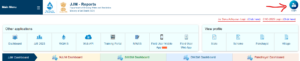
STEP 3
Now, enter your login details including your login ID and password. Verify this by entering the CAPTCHA.
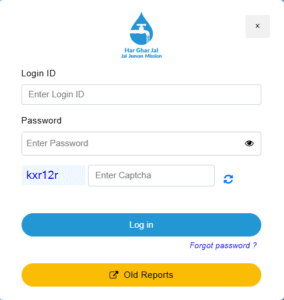
This is basically to view the JJM reports.
How to Access the Official JJM Portal?
For national-level information, users should begin with the official Jal Jeevan Mission website. The portal provides information about the mission, guidelines, reports, dashboards, water-quality systems, training resources and other programme components.
The practical approach is:
- Open the official Jal Jeevan Mission website.
- Select the relevant MIS, dashboard, report or digital service.
- If a login is required, choose the appropriate authorised user category.
- Enter the credentials or OTP requested by the official portal.
- Use the relevant dashboard or service after successful authentication.
If you are a general citizen looking for information about your village or household, you may not need an official departmental login. Public dashboards and village-level information may provide the required details without requiring administrative credentials.
What Are the Benefits of Jal Jeevan Mission?
There are several major benefits of JJM in detail-
- Jal Jeevan Mission is about access to piped drinking water at the household level in rural areas. However, the impact goes beyond the installation of a tap.
- Reliable water supply can reduce the time families spend collecting water and can improve convenience, hygiene and household well-being.
- It can be particularly important for women and girls, who traditionally bear a large share of household water-collection responsibilities.
- The mission also aims to improve water quality and encourage sustainable management of local water resources. Measures like rainwater harvesting, groundwater recharge and greywater management help address the problem of maintaining water availability over the long term.
- Another important benefit is local participation. Through Gram Panchayats, VWSCs and community-based activities, JJM 2.0 seeks to make rural communities active participants in managing their water infrastructure rather than treating them only as beneficiaries.
How Does JJM 2.0 Help Villages in the Long Term?
The real value of JJM 2.0 lies in its attempt to solve the sustainability problem.
Lets understand it with an example-
Suppose a village receives a new pipeline and household connections, but the water source dries up, the pump fails frequently or there is no mechanism to pay for maintenance. In that situation, infrastructure exists, but the water services are unreliable.
JJM 2.0 attempts to address this gap by connecting infrastructure with –
- Operation and maintenance
- Source sustainability
- Water quality monitoring
- Community ownership
- Digital accountability.
That is the reason the government’s current approach is increasingly focused and described as a shift from “Infrastructure creation” to “Service Delivery.”
Latest Jal Jeevan Mission 2.0 Updates in 2026
Several developments have taken place during 2026.
- The Union Cabinet approved JJM 2.0 on March 10, 2026, extending the mission until December 2028 and increasing the total outlay to ₹8.69 lakh crore, including ₹3.59 lakh crore in Central assistance.
- The Operational Guidelines for JJM 2.0 were subsequently published by the Department of Drinking Water & Sanitation, providing the framework for the new implementation model.
- More recently, in August 2026, the Government reported that ₹5,289.09 crore had been reimbursed as Central share to 10 States during FY 2026-27, while ₹865.87 crore had been released through the SNA SPARSH platform across 13 States.
- The same update highlighted reforms including Jal Arpan, Sujalam Bharat IDs, geo-tagging and digital mapping, Jal Seva Aankalan and stronger emphasis on sustainable service delivery.
- These developments show that JJM 2.0 is moving towards a system where the performance and sustainability of water services matter as much as the creation of infrastructure.
Frequently Asked Questions (FAQs)
Q. When will Jal Jeevan Mission 2.0 end?
Ans. The Union Cabinet has extended the mission until December 2028.
Q. What is the budget of Jal Jeevan Mission 2.0?
Ans. The total approved outlay is Rs. 8.69 lakh crore, including Rs. 3.59 lakh crore in Central assistance.
Q. What is Sujalam Bharat?
Ans. Sujalam Bharat is the uniform national digital framework being introduced under JJM 2.0. It is designed to digitally map the drinking-water supply system from source to tap and assign villages unique Sujal Gaon or Service Area IDs.
Q. What is Jal Arpan under JJM 2.0?
Ans. Jal Arpan is the formal handover process for completed water-supply schemes to Gram Panchayats and Village Water & Sanitation Committees, strengthening local ownership and accountability.
Q. Is Jal Jeevan Mission only about giving tap connections?
Ans. No. JJM 2.0 places substantial emphasis on reliable service delivery, water quality, operation and maintenance, source sustainability, community participation and digital monitoring in addition to household tap connections.
Sum Up
Jal Jeevan Mission 2.0 represents a significant change in India’s approach to rural drinking water infrastructure. The objective is to ensure that those taps continue to offer safe, adequate and reliable water. If you have been looking for the JJM website, portal or anything else related, then this guide covers everything. For more such informative government tenders across India, you can stay connected with Tendershark. We are the industry’s most trusted platform to freely search unlimited tenders.